I am commitment phobic only as an eater. Despite the most imploring waiters trying to seduce with today's most special special or catchiest catch, I would rather have three appetizers or five bites from someone else's plate. This drives my friends and lovers crazy. It's amazing how possessive some people are about their food.
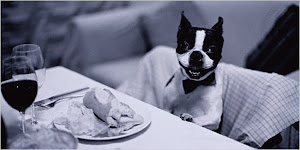
So, it was a wonderful affirmation of near Oprah proportions to read the New York Times' story on the death of the entree. (for a full bite of the real thing: http://www.nytimes.com/2007/12/05/dining/05entr.html) The rationale? Too many bites of one substance is just too....boring. Now, those of us raised to feel guilty for all the starving children in countries denied the luxury of grey beef and over-cooked vegetables will certainly suffer an anxiety attack at the thought that decent food is "boring" but that is what makes one newspaper a courageous truth-teller while others are merely earnest.
" “As a diner, the idea of me chewing 17 bites of one thing and another 17 bites of another is absolutely boring, and not how I want to eat,” said the chef Mario Batali." Can you get over that? How ballsy!
But the thing is, and it has been the thing for a while, it's far more fun to taste a lot of things than to settle on just one choice. I don't know what your excuse is but it is sheer ADD on my part. I can't actually decide or focus on WHICH kind of shrimp I want, or whether the lamb dumplings are preferable to the crab. Let's get them all.
When you think about it, this is more suited to our lifestyle than the plate of protein with a side of starch our parents and grandparents felt was their due. We are not ploughing fields. We are not hammering nails. We barely need more than a bite in order to keep all functions functioning. That we want to spend that bite or two wisely, to make it an experience, is in its own way practical. Eating is not mandatory in the way it was for toilers and hewers, it is now a social experience. Don't skimp on it.
Thursday, December 6, 2007


Tuesday, December 4, 2007
Black Swan Green

I didn't think growing up had much to say for itself except that one day we knew it would be over. As a sad kid I always projected myself into the Future, where things would be better (they could not be worse) and I lived more happily in this fantasy world than in the real one.
Lately though I've been drawn to books either intended for young people intent on growing up (it does seem to be a choice nowadays) or about young people trying to grow up, and the latest in this reading series has been Black Swan Green by David Mitchell, touted as being the "British Catcher in the Rye." Always beware of these sorts of references. They are never true and frankly do a disservice to both books.
Leaving that pet peeve aside, this is a good book. In it we have 13-year old Jason Taylor who lives in a sleepy village called Black Swan Green where there are no black swans or swans of any colour. Jason stammers, different from stuttering, which makes speaking a high-pressure situation. Imagine having to dodge words fast enough not to give away the fact you are dodging them; imagine not being able to rely on your very self to speak your very own mind.
For a number of reasons central to who he is Jason is set upon by bullies. I liked this part very much, having lived in a few sleepy places myself. Those who live in big cities, I've noticed, talk about the pastoral pleasures of small town life and in my experience small towns are more venal and vicious than a city in that word spreads faster and you can't get away from it, there are no other circles for you to live in.
Behind this drama is another one. Unbeknownst to Jason, because he is young, and obvious to us, his parents' marriage is disintegrating. What is also clear to us but not to Jason, his dad is hanging by a thread at work. This is nicely played in the book, a champion bit of writing in that Jason pays no never mind to the signs and we can't miss them. See, we did learn a few things along the way after all.
Jason is bullied mercilessly and frankly, not being overly astute politically myself, I could see no way out of it. But all of a sudden Jason grows up, grows into himself, takes on the bullies in his own way, tells the truth, tells lots of truths and suddenly, simply by standing up for that very thing, the truth, the sting is gone. Bullies slayed. The crippling fears he has felt disappear. All in the power of a small action and a few clear words.
Jason grows up, in other words, and it happens all of a sudden as it probably does in life. Is that how it is? One day we are children and then another day, all of a piece, we are not? I liken this to the stomach flu, my best definition for utterly defined and impermeable states of being -- in illness we cannot actually imagine ever feeling well; healthy, we cannot imagine the feeling of sick.
And while Jason has been as benignly indifferent to his parents as they are to him (well, except for the fear of punishment thing) and despite the fact his father seems a prat, the fact his family is shattered is a change he finds hard to take. Naturally. His father has nearly bankrupted his family to look after another woman which believe you me is the talk of the town in good old Black Swan Green, but life is not so stark. As it turns out, the woman is a childhood friend, far more plain and speaking less "posh" than Mum but nonetheless the one dad prefers (to be brutal about it) or the one that fits him better. The father, now that his own truth is out, is softer, kinder, more human.
Leaving his home for the last time, the home that is no longer his in any way, Jason fights tears -- after all, he's a man now and nearly 14. "It'll be all right," his older sister says. "In the end, Jace."
"It doesn't feel very all right."
"That's because it's not the end."
So there you go. As far from childhood as we may be, there's still something to learn. If it still hurts, it's not yet the end.
Sunday, November 25, 2007
With the Grace of Liberace Go I
Is it cheating to write about books other people have read which I have not read myself? Oh dear, we hate to cheat.
In my beloved NYT I stumbled across a story written by a soul sister. She felt she gave awful parties and so did some research and began collecting books on "gracious living" written years and years before Martha Stewart put pan to parchment paper. She found "cheerfully deranged" tips for not only throwing a nice party but for living glamorously, and who doesn't want to do that? Not you, really? Well, try it before you judge it.
This initial interest led to collecting said books which now take up a special shelf in her library. At first my soul sister Jancee Dunn would kick off her parties by actually reading aloud the stranger bits to the laughter of the crowd. But I think she started to get something more out of them and stopped making so much fun of these helpful friends.
When I was a kid on the bald open prairie (we at home rarely said "prairie" without the "bald open") I craved a life less dusty. A life that maybe had more people in it, and people who did things other than talk about the weather which is, to be fair, a live or die element of life on the B.O.P. Somehow or other I got my hands on an old home economics text book which was probably in a box picked up at an auction as I cannot imagine anyone picking such a book out for me in a second hand book store. Anyway none of that matters, what matters is the book was a fascination for me. It talked about how to BE in the world, how to dress and speak and how to keep hairbrushes "fresh" and things like that. Can you imagine anything so intoxicating to a pre-adolescent freaked out by the judgement of the world? Never mind that the info was even then already two decades out of date.
This sort of "ideas for living" book is now a constant favorite though books of this nature are hard to find. Yes we have Martha but she's sort of, I don't know, stern and what we want is something a bit more celebrating. Jancee sums it up nicely: "...the more I read these cheery books, the more I discovered that what I loved about them was their offbeat joie de vivre, their plucky contention that with wit, verve and maraschino cherries, anybody can live a fabulous life."
That's sort of a nice idea on a rainy day, isn't it?
My own book list includes Elegance by Genevieve Antoine Dariaux who contends that god may not have made you beautiful but anyone can be elegant with the right gentle direction. The book speaks of women of the past who seem to have changed clothes about five times a day (morning dresses? what that?) but what the book really says to me is be respectful of your very own self. Then there is Entre Nous, A Woman's Guide to Finding Her Inner French Girl which is similar in intent. A French girl thinks before she speaks, guards her privacy carefully, chooses intellectual pursuits over the giddy charms of giddy charms. Very encouraging advice for a woman who feels like the trick pony at parties. Even The Bombshell Manual of Style, written in 2001 so a relative newcomer to the genre, has its place in that it encourages us to take good care of ourselves and to vet any new friends and boys to test their worthiness before they are allowed into the inner sanctum. That's kind of a fun idea.
Jancee has done even more sleuthing than me and so I am now on the hunt for some of her finds.
"The dictum of these vintage books was always "Be larger than life" -- markedly different from the message of modern-day tastemakers like Martha Stewart, Rachael Ray and Nate Berkus, who propose the more succinct "Be me." " Doesn't that sum up the current oeuvre? Martha is a dictator, telling me to clean up my room. I hate that.
I like the idea of the old girls' eccentricities (in Sex and the Single Girl, for example, Helen Gurley Brown suggests a brunch cocktail made of boiling down four cups of coffee to one, then adding gin and vanilla ice cream. Madness! But probably makes for an interesting party....) I like the idea of having FUN with life, and if Jancee calls that being larger than life, so be it.
You can't do anything about the weather or the face god gave you. Might as well throw a party.
Friday, November 23, 2007
Books for kids
Back in my day, books written for "YA" or young adults as it is called now, involved sporty girls who got themselves into scrapes. On the young end of the spectrum there was Harriet the Spy (a personal favorite, nosy little writer that she was) and Trixie Beldon and of course dear Nancy Drew (pain in the butt I always thought, bloody prissy princess). Back then, life was harsh but the books were gentle -- Nancy, for example, had no mother (interesting, that) and a lovely dad, she was perfect, poised and pretty, there was some housekeeper or other around, and her friends fell into two cardboard camps: there was a tomboy and there was a soft and gentle nice girl named Honey if I recall, who was "pleasantly plump" whatever that means. Once you graduated from these sweet tomes you were onto real books, like The Catcher in the Rye and such before you moved on to Harold Robbins or Henry Miller for instructional purposes.
Lately I've been reading a number of books meant for young people, and what a sea change. It may be trite to say it but it seems to me that LIFE for young people has become gentle and easy (buy me take me show me being their mantra, and their parents snap to attention and buy, take, show) but their books are harsh. It is amazing to me that adult writers can so powerfully depict the pain and angst of childhood and youth. These books are like perfume -- as a scent can immediately transport you back to a time and place, these books artfully remind me of the crushing griefs and embarrassments of a cruel world we barely understand.
What I Was is written by the amazing Meg Rosoff, who also wrote the wonderful How I Live Now. Both describe youth as being its own country, cut off entirely from mysterious adults and their mores.
What I Was speaks of the chaste love affair (of the deep friendship kind, the best kind) between two boys. This friendship is the only softness either knows; the narrator is in British boarding school which we are given to understand is cold in every way and filled with bullies and the ever-dangerous weak, both bent on destruction. It also speaks of the intense passions of that age, and what I had not considered is how transforming they are. And they are. I remember well a great love of my life, my best friend in highschool, who went off me for a reason only she knows. The anxiety and despair this rejection caused can still bring me to my knees when I think about it. It set me up for a million disappointments -- an early lesson, yes, and a painful one.
Black Swan Green by David Mitchell also describes a young British schoolboy, this one a stammerer who is tormented by Hangman (who gets in the way of the language he wants to use) and Maggot, inner demons both. His parents are each in their way soulless, fighting with each other about something that lurks beneath the surface. Adulthood looks dreadful, the present is fraught with the cruelty of peers and our boy must make his way through minefields of all kinds -- even his own inner spirit works against him, strangling his words.
I have said it many times but still, I don't know how we survive childhood. Few of us survive it intact. It is wonderful to me that writers can turn such experience into wisdom and art.
In a way reading these books is therapeutic. We recognize the slights the protagonist is enduring, we went through them ourselves. We support him, love him, want to protect him. We hate his enemies. The lesson then, is that the wounded soul really did deserve to be cared for, it is so obvious on the page, and this is something we can take into life. Kind of a revelation, that.
Wednesday, November 21, 2007
The stories you tell yourself.
She is five. Hoping for good news. She is with two people, waiting -- one loves her but she doesn't know it or feel it; she loves the other absolutely and can't know or feel that the love is not reciprocated. The news comes and it is not at all what she hoped for -- the baby is a boy. What this means, for her, a girl, is that she has no sister, no ally, no hope. She is utterly, totally, alone. No one will help her or save her. Or know her, for that matter. It is now all over. Her last chance.
She reacts badly. Shattered, crushed, destroyed. Her eyes are coals, bright and shot with tears, haunted, horrified. Unbelieving. It cannot be true. That the universe can be so cruel and so dead set against her. She is five.
I hate him she says, I hate him already and the aunt says (the treacherous aunt) No you don't. So. It is utterly true. No one sees her, knows her, cares. She is on her own now and now she decides -- she doesn't know she decides, she's just five, but she decides nonetheless -- well, if they all want to hurt me, if there is no one in the universe to love me, I will hurt myself ten times as much. I will exceed their hurt, I will excel past where they would go, I'll show them. She's five. It's five year old logic.
Sunday, November 18, 2007
Love in the time of dementia
The story in the NYT's Week in Review begins thusly: "So this, in the end, is what love is."
The story is about love and age, and begins with the example of Sandra Day O'Connor, the first woman named to the US supreme court, and her husband who suffers from Alzheimer's. He is in a nursing home and has fallen for someone else, and Sandra is pleased. The O'Connor's son reports that his mom is happy to see her husband of 55 years happy and content, and even visits the new couple, chit-chatting with them as they hold hands on a porch swing.
New love, the story goes on to say, is all about the thrill of it all and wanting to be happy. Old love apparently is about softer things and wanting someone else to be happy.
There is even a claim in the piece that as the brain ages (that means, as we age) we become easier to please, more inclined to see the good over the bad, better able to deal with the vicissitudes of love. Studies guaging reactions to positive and negative scenes indicate that young people react to the negative, middle aged people see a balance and the elderly respond only to the positive. As people get older, therefore, they seem to naturally see the world in a more positive light.
Oh my, there is so much to say about all this.
First of all, where are these studies and what lobotomized old people did they find to do them with? I have worked in many a nursing home including those filled with Alzheimer's sufferers and other demented souls and I can tell you, the elderly are often deeply crabby to the point of pure evil. It may be sunny and lovely outside and everyone may be perfectly pleasant but by god, you should have understood that the mushy squash goes on the LEFT side of the plate.
The O'Connor "love" story strikes me in a few ways as well, and few are positive. First of all, and this is an idee fixe of mine, it is definitely a man's world. Here we have a demented old man in a nursing home and he can still find a date. There is no mention of the brilliant, talented and accomplished Sandra having same; in my own case we have an imperfectly sane bombshell sitting at home alone on a Saturday night. Ms O'Connor, WHERE is the justice in all this? This story strikes me as being painfully close to that of Stephen Hawking's sorry love life -- wherein we have a man who is virtually helpless and has had to depend on his good wife for absolutely everything including the messy bits having to do with bottoms; he is a man who is undoubtedly weird, certainly weird to talk to with that manufactured computer voice and all, and yet he still is able to run off (though "run" may not be the word) with the nanny, his own nanny but nevertheless. He may be twisted to gnome proportions and impossible to understand but by god and by gar, he still has romantic options.
If this sounds like the twisted gnomes of the world don't deserve love, forgive me. Of course that is not what I mean. It is that no matter what, MEN are still considered sexy and attractive, a "catch", long past the point where a woman is. Why can't the world love an adventurous woman is it does and adventurous man?
In my next life, please let me be a man. And if yes, may I not be born into the time of Amazons? I want just once to feel what it's like to be a winner.
What the studies and the article seem to suggest is that as we grow older we grow wearier of the fight for that elusive happiness of being loved absolutely by someone we love absolutely. We grow accustomed to compromise, to infidelity, to the let-down -- a crumb is okay, at least it's something.
Perhaps this beats abject heartbreak at 80. Heartbreak today nearly kills me, I don't know if I could withstand such a thing with a frailer heart than the one I have now. Perhaps this general giving in is simply biology -- the body's desire to survive where the heart and mind would not.
Sunday, November 11, 2007
Shutter Island
I love a good shimmy-shammy, in books if not in life. Others might call this the "surprise ending".
Asylum by Patrick McGrath is a terrific example of this type, and even Incredibly Close has a bit of a twist; in movies it's as famous as The Sixth Sense though even better versions include Lilith or Bunny Lake is Missing. Playing a trick on a dear reader is a noble tradition in mysteries spawned by Agatha Christie but it's really best when it is more psychological that that. What do you know, and how do you know you know it?
Shutter Island by Dennis Lehane is such a "hey wait a minute" story. Lehane elevated himself above the average one-a-year mystery writer with Mystic River, a truly complex story of not knowing what you know and the madness caused by pain and injustice. Shutter Island predates that book and contains elements of its consideration of how much grief the human mind can tolerate.
To say much more would give away the surprise. If you have a rainy Saturday afternoon to yourself, spend it on Shutter Island.
Subscribe to:
Posts (Atom)